
Neo Fulkrum: 26 checks on every contract.
Neo Fulkrum is AI contract screening and governance for Fulkrum. Every client and supplier contract is checked against 26 points, findings go to the right people, and nothing is approved until every issue is resolved. Review cycles are up to 80% faster.
- Client
- Fulkrum
- Screens
- Client and supplier contracts, POs and work orders
- Checks
- 26 on every contract
- Result
- Up to 80% faster review cycles
Why it needed building.
Fulkrum signs commercial contracts with clients and suppliers, including agreements for inspection and asset integrity services. Each one needs the same careful checks: payment terms, liability, penalties, data protection. Purchase orders and work orders can then add terms of their own that conflict with the contract.
Done by hand, that review is slow, it depends on who does it, and the reasoning behind each decision is hard to trace later. The aim: automate the first pass, keep people in charge of the decisions, and leave a trail that governance can rely on.
Neo Fulkrum, feature by feature.
26-point AI screening
Every contract is checked against the same 26 points, so the first review never depends on who happens to pick it up. Findings flag missing terms and anything that needs human review.
POs and work orders checked too
Associated purchase orders and work orders are screened for additional or conflicting terms, so nothing slips in after the contract is agreed.
Clause review workspace
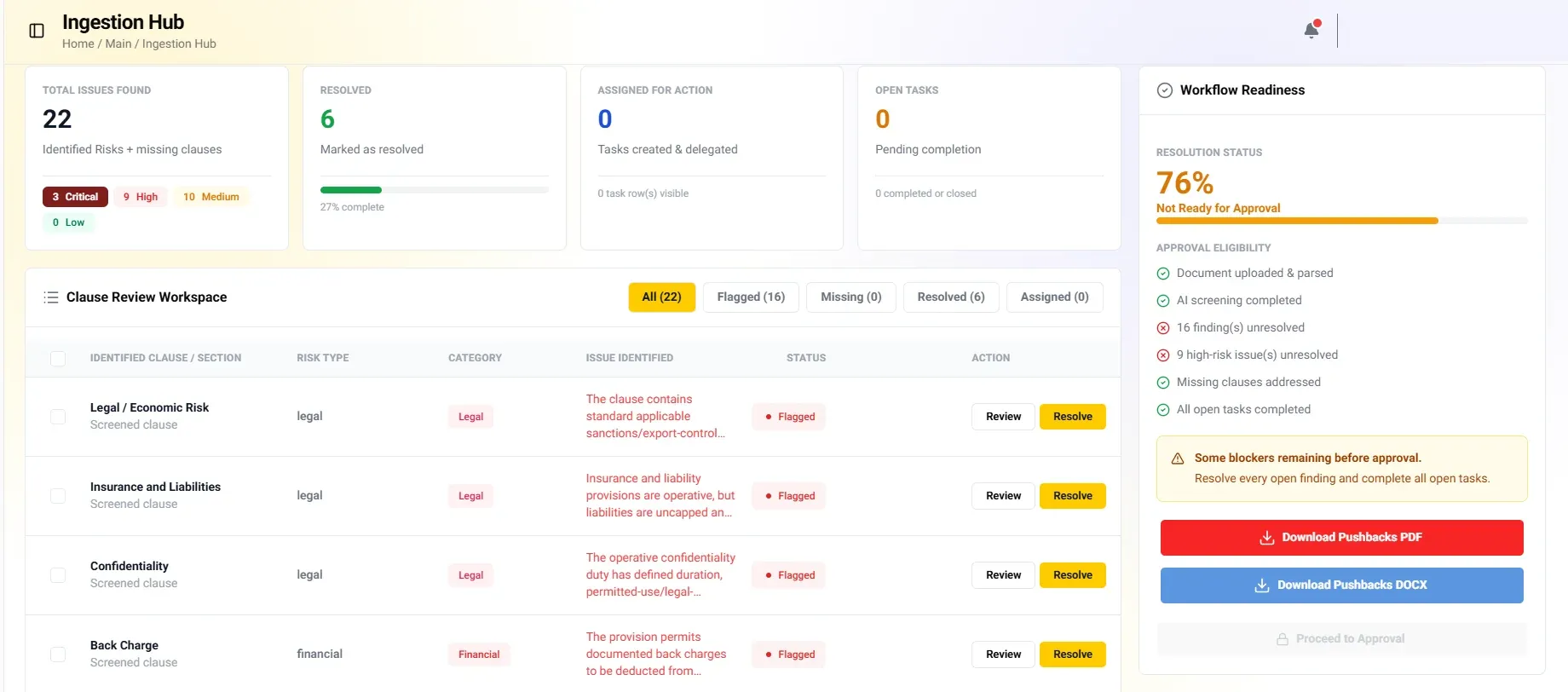
Each finding lists the clause, risk type, category and the issue identified, with severity from critical to low. Reviewers filter by flagged, missing, resolved and assigned.
Roles and sign-off
The commercial team reviews the AI findings, regional managers and assigned colleagues resolve issues as tasks, and authorized approvers give final sign-off, ending with the commercial lead.
Approval gate
A workflow readiness panel tracks resolution. Approval stays locked until every finding is resolved, high-risk issues are cleared, missing clauses are addressed and open tasks are done.
Pushbacks and audit trail
Findings can be exported as a pushback document in PDF or Word to send to the other party, and every check and decision is recorded for audit.
What every contract is checked for.
A selection of the checks Neo Fulkrum runs on every contract.
Payment terms
Checked against Fulkrum’s 30-day payment target.
Insurance and liability
Required cover is present, and liabilities are not left uncapped.
Penalties and liquidated damages
Penalty and liquidated damages clauses are found and flagged for review.
Retention and withholding
Terms that let payments be held back or deducted are surfaced.
Tax obligations
Who carries which tax obligations is identified.
Confidentiality and data protection
Confidentiality duties and personal-data processing terms, including GDPR, are reviewed.
Dates, renewals and extensions
Contract dates, renewal terms and extension options are extracted.
Required certifications
Certifications the contract requires are listed so they can be confirmed.
Upload to approval.
A contract goes through AI screening, review, resolution and sign-off, and every step is recorded.
New contract
26 checks queued
Screening · 18 of 26
22 issues found
Assigned for action
Workflow readiness
What it delivers.
Faster contract reviews
Manual vs AI-assisted review timeChecks on every contract
Neo Fulkrum · contract AIThe difference it makes.
The AI does the first read, so reviewers start from what the screening found and spend their time on the decisions that need a person. The checks are the same on every contract, and the purchase orders and work orders that follow are held to the same terms.
Nothing reaches sign-off with open issues, and the trail of what was found, who resolved it and who approved it is there when someone asks why.
Review speed is measured by comparing equivalent manual and AI-assisted reviews: time saved as a share of the manual review time.

Have something like this in mind?
Tell us what you're trying to solve and who it's for. We'll tell you how we'd approach it.